
In an age of AI, where code is cheap and anyone can spin up a website or app in an afternoon, good design and user experience are what separate a mediocre product from a memorable one. We all know the AI giveaways: the same fonts, the same rounded cards, the same three-column feature grid, and copy that says a lot without saying anything.
Reading job descriptions for designers lately, I keep seeing “taste” and “craft” listed as requirements. I can’t help but picture a small-batch brewery, with bartenders in curly mustaches and sleeve tattoos pouring you a hazy IPA.
If AI slop is Bud Light, then “taste and craft” is the local craft brewery down the street.
But what do these buzzwords actually mean when it comes to designing great products?
I am reminded of Aarron Walter’s Hierarchy of User Needs, from his 2011 book Designing for Emotion. Walter took Maslow’s hierarchy of needs and remapped it for digital products. A product has to be functional first, then reliable, then usable, and only then can it be pleasurable.
Another important tech shift was happening around that time. In 2008, Apple’s App Store and Google’s Android Market (now Google Play) went live, and within a year Apple alone had passed 1 billion downloads.
Suddenly people had more software choices than ever, right in their pockets. When ten apps do the same thing, it’s not enough to just work. Companies had to raise the bar by making the experience usable for their audience, and even delightful.
That’s when UX design went mainstream. The term itself is older: Don Norman coined “user experience” at Apple back in 1993. But the app era turned it into a role on nearly every product team. Don’t get me wrong, this was never just about visual design. It was about solving real pain points, making things intuitive, helping people get through their tasks without friction, and creating moments of delight.
Now we’re seeing the same shift again. In 2025, “vibe coding” went from a tweet to a dictionary’s Word of the Year. AI has made the bottom of the pyramid cheap. People without an engineering background can build something functional, and more and more often something reliable. What AI can’t do for us is decide what’s worth building, or make the experience useful, usable, and delightful. That’s where taste and craft come in.
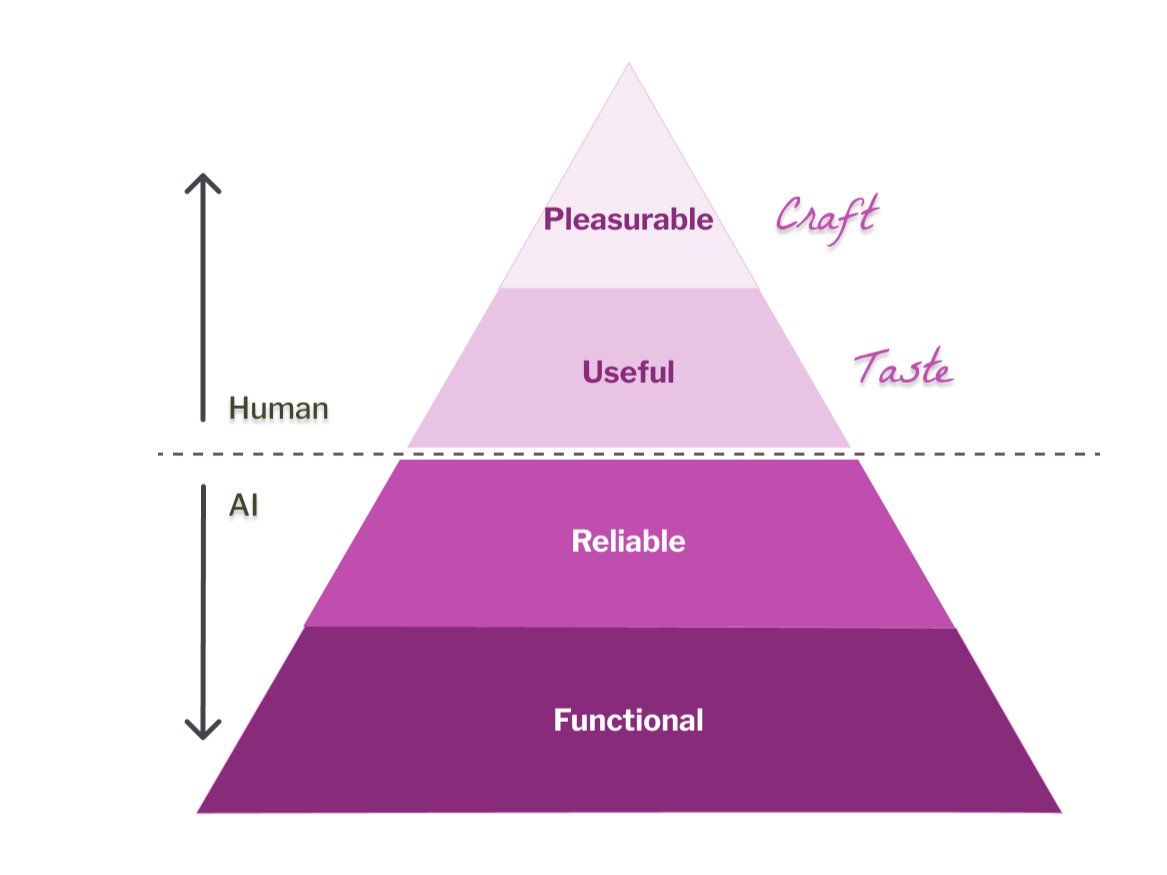
Taste
Taste is about judgment. Just because AI can build something, should it? Does it solve the problem at hand? Does it address users’ needs and pain points? Does it align with their mental models? Does it solve the user’s problem in a way that is unique from competitors?
Craft
Craft is polish and attention to detail. It's about reviewing the AI output and using your own knowledge and expertise to correct errors.
Craft is creativity. AI is excellent at recognizing patterns, mimicking what has been done in the past. Human creativity is about breaking patterns and thinking in totally new ways.
Craft is originality. In a sea of AI-created sites that all look the same, it’s the small bespoke design touches that make one stand out.
Craft is care. It’s the empty state someone actually thought about, the error message that sounds like a person wrote it, the tiny interaction that makes you smile.
Together, taste and craft are what make products feel human.
So it turns out “Taste” and “Craft” aren’t new buzzwords. They’re a rebrand of what UX designers have focused on for decades: making products that are useful, usable, delightful, and human.