Leveling up my baking and AI skills, and the app I built along the way
Part 1: Getting started
A friend handed me a baggy of fermented dough and some verbal instructions on how to keep it alive. That's how I ended up with a sourdough starter and, eventually, an app.
My husband and I had always liked sourdough, but baking it myself felt intimidating. Then I lost my job and suddenly had time on my hands and an itch to do something productive with it. So when my friend offered to share her starter with me, I said yes.
Like most people, my first stop was Google. Looking up “easy sourdough recipes”, I quickly found that while the ingredients for each recipe were more or less the same, the steps and level of nuance were all over the place. I also discovered that the end-to-end process for a bake spanned over 36 hours. I was overwhelmed before I even began.
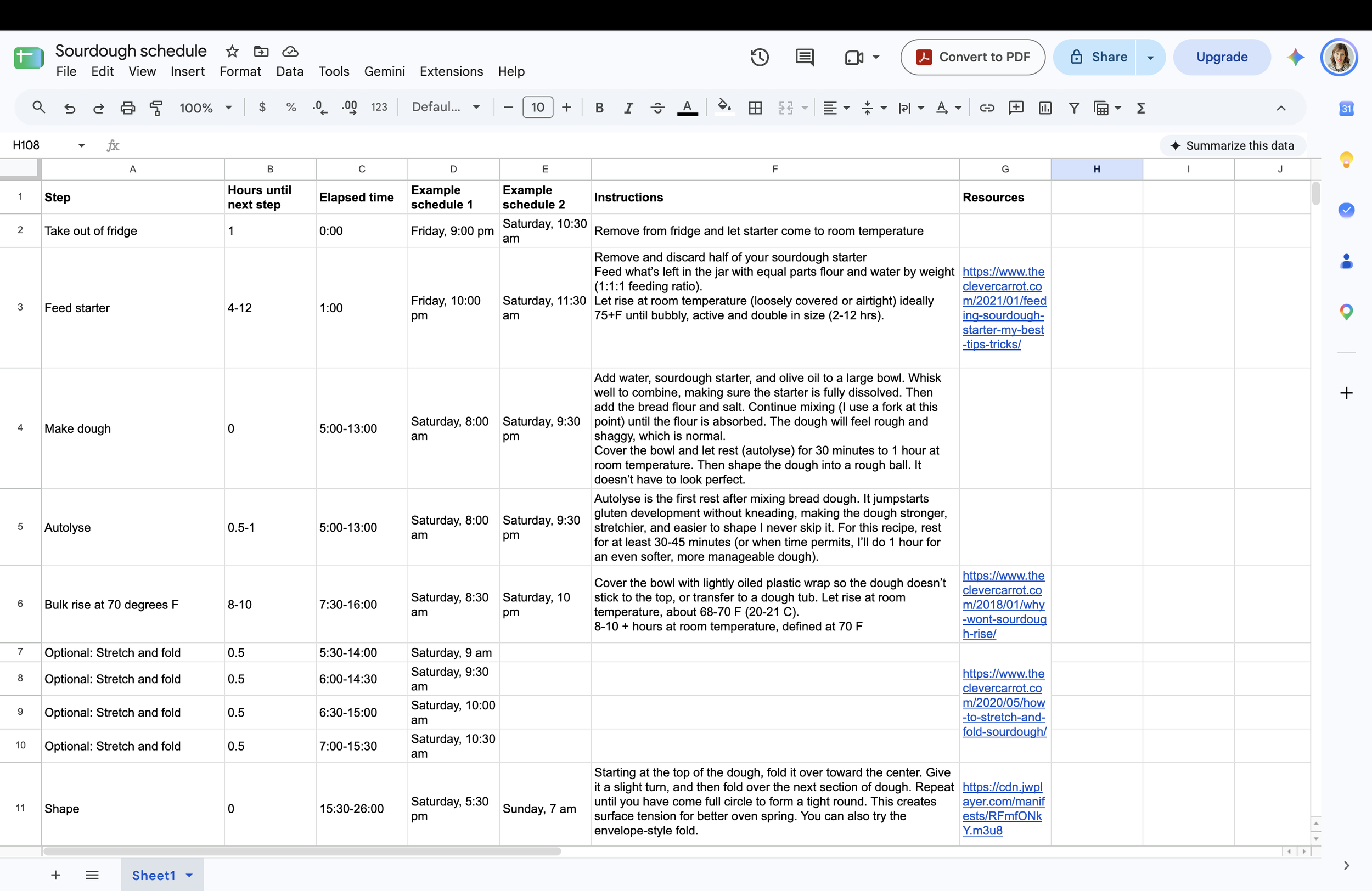
So I did what I usually do when handed a lot of complexity: I made a spreadsheet. I laid out every step and its timing, then plotted it backward from a start time. I wanted to avoid needing to complete a step overnight or when I needed to be somewhere during the day.
While the spreadsheet helped, it only solved the timing problem, not remembering how to do each step. I now found myself toggling between a spreadsheet, a recipe, and various demo videos. Despite this, I plodded through my first bake, determined not to be blocked by overwhelm. Was it great? No. Was it edible? Sort of. But it helped me get over that first hump and be ready to keep iterating.
At the same time, I wanted to dig deeper into AI tools and figure out how to best incorporate them into the product design and delivery process. Yet, like baking sourdough, it felt overwhelming, and I didn’t know where to start. I know everyone kept saying “the best way to learn is to experiment”, and I had been doing quite a lot. But experimenting in a vacuum only gets you so far. I wanted to do more, but I needed some direction and a real project to apply AI to.
I found an online course through Coursera called “GenAI for UX Designers” that looked promising. When asked to come up with a product idea I could use for the assignment tasks, I realized I could meet both goals by learning to build with AI by creating an app that would help me better plan and execute my sourdough bakes. The idea for the Sourdough Baker’s assistant was born.
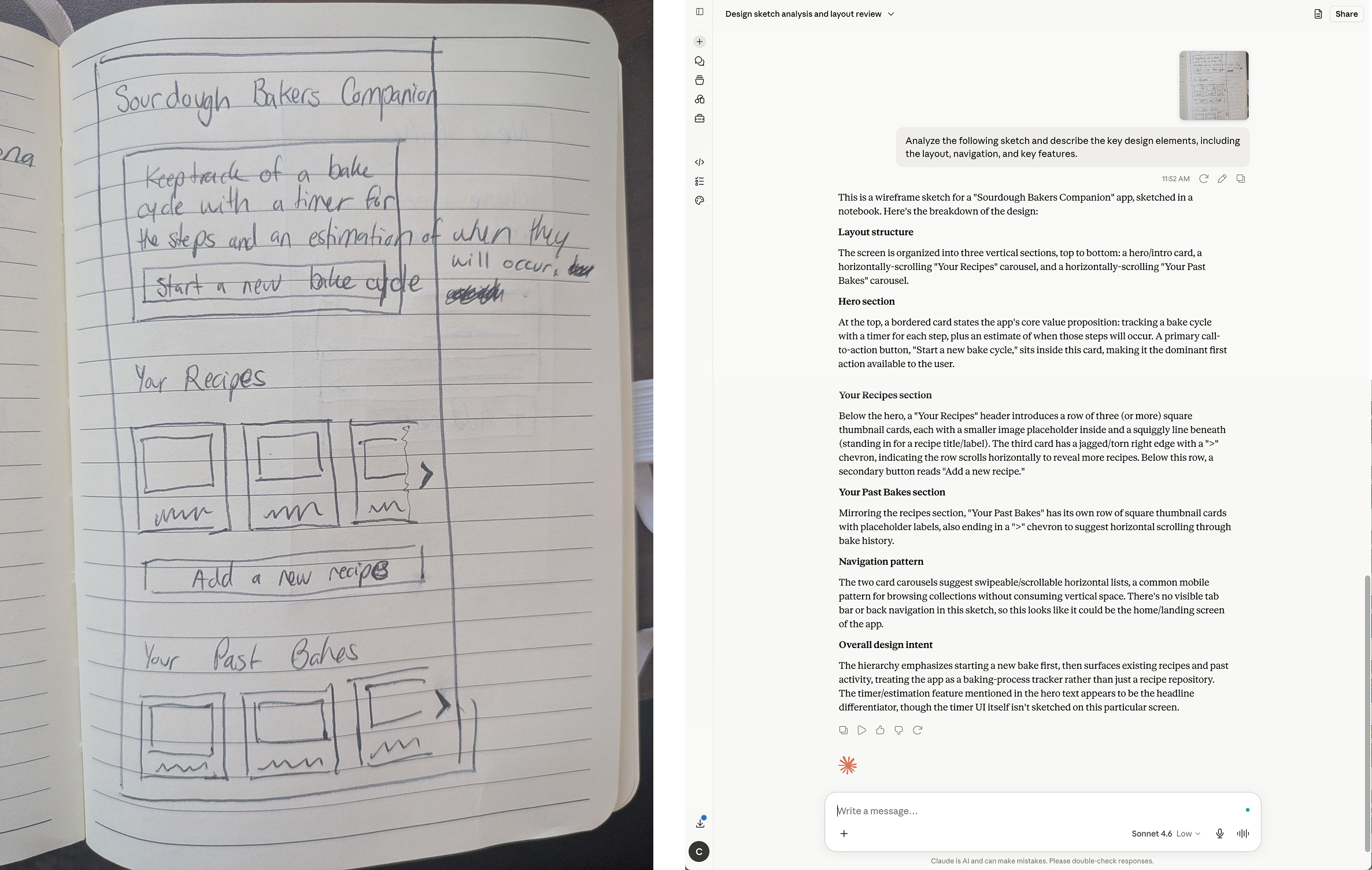
The first task was to create a sketch or two of an app, upload it into your AI tool of choice (my preference was Claude), and ask it to analyze the sketch and describe the key design elements, including the layout, navigation, and key features. I was a little skeptical, but I uploaded a quickly drawn, rather crude wireframe of my sourdough app idea and gave it the prompt. I was shocked by how accurate it was. I felt like I was talking to another designer, analyzing an early concept together. Not only did it get the design components right, but it also picked up the content from a small amount of (badly printed) text in the wireframe. This opened me up to a new level of possibilities with Claude.
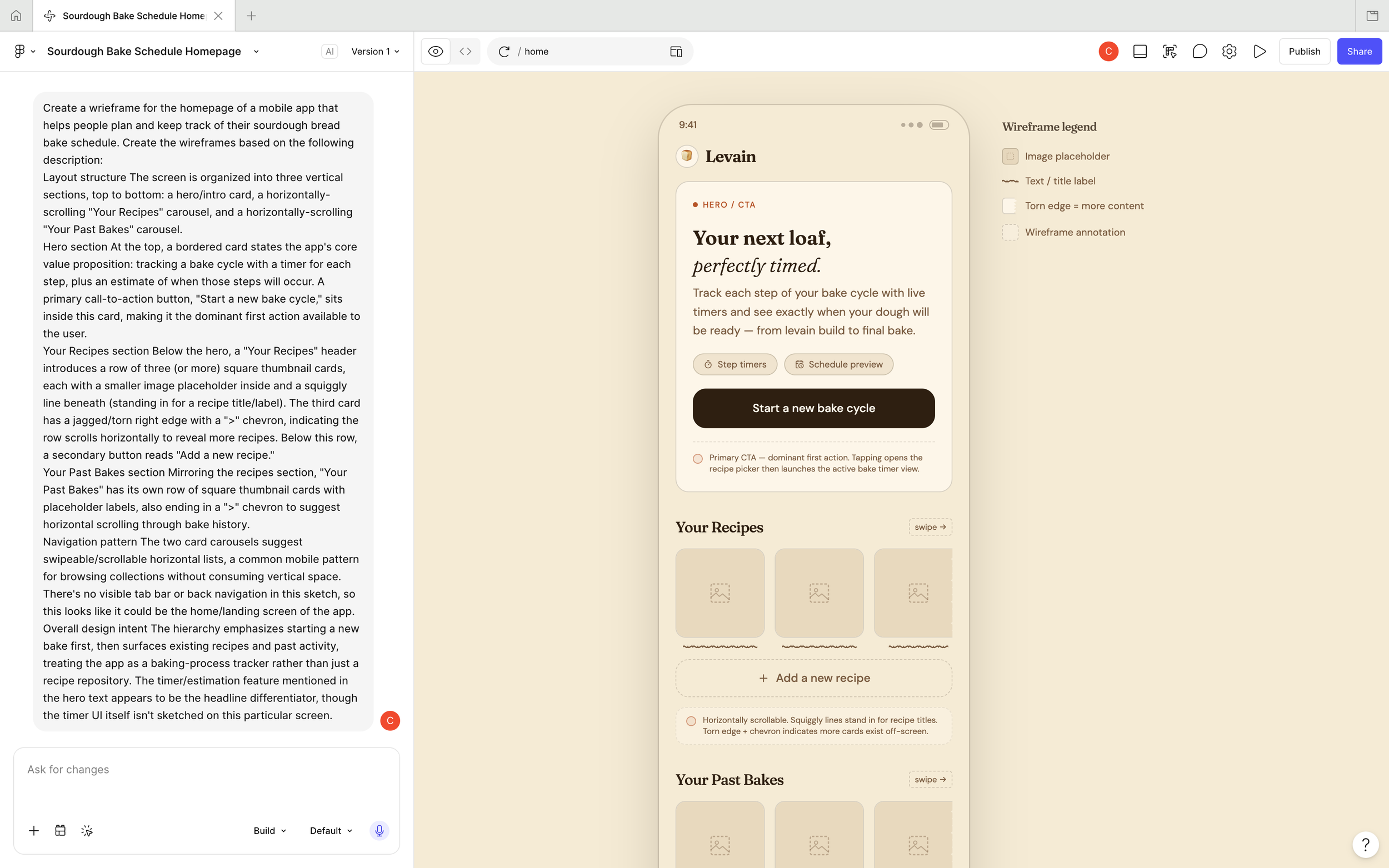
The next task was to give the AI-generated sketch analysis to Figma and prompt it to create a wireframe based on the description. Again, I was happily surprised with what it generated. Was it a perfect design? No. But it was a great way to quickly go from ink on paper to pixels on a screen so I could then start finessing the UI. It also generated some design ideas that I may not have tried myself, which gave me options to play with. I was also once again impressed by the level of context it baked in, explaining its design choices and referencing common mobile UI patterns and best practices. It even pointed out missing components that I hadn’t included in my sketch, such as the lack of a navigation tab bar or a back nav button.
Make it stand out
This was a great first step in learning what AI tools could do, but the app concept was only a home page with little depth. Before going further, I needed to define an app vision and requirements. Something I was pretty sure AI could help me do….
Stay tuned for more on the end-to-end process of how I designed, built, and published a native app with the help of AI.